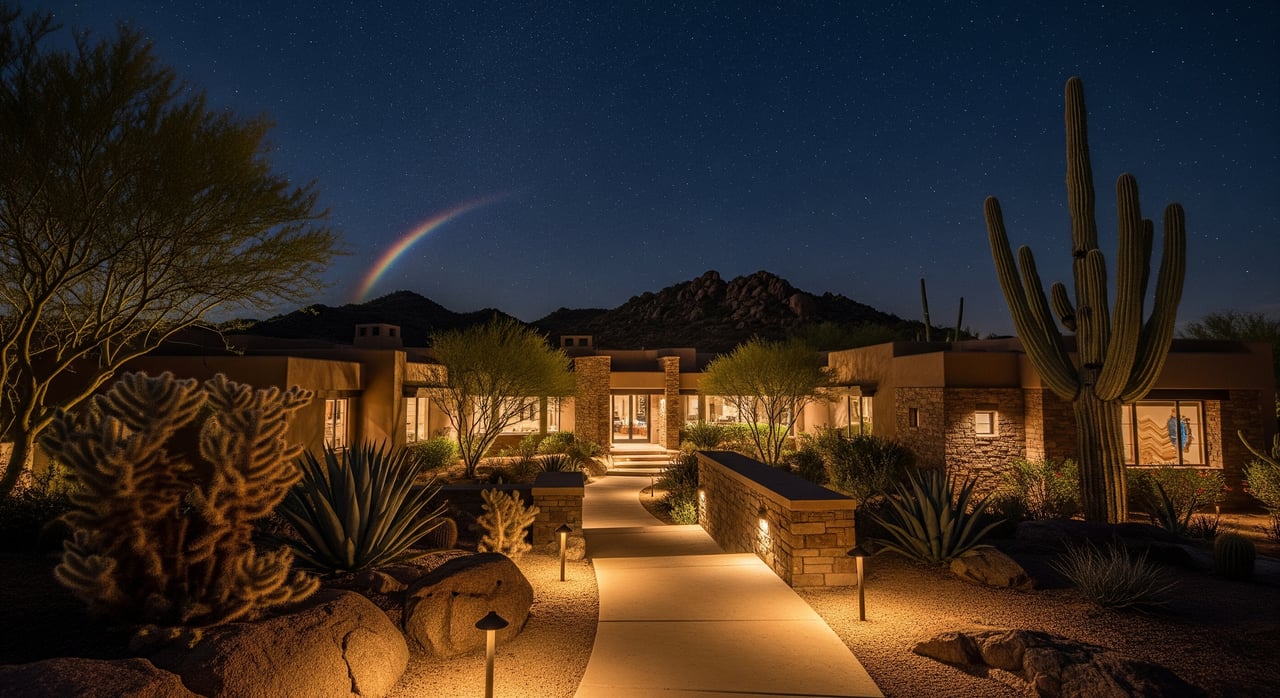
Love the way the stars pop over Black Mountain at night? Smart outdoor lighting helps you enjoy that sky, keep peace with neighbors, and stay compliant with local rules. If you are buying in Carefree or refreshing a home you own, you want clear guidance that keeps your project simple and on schedule. In this quick guide, you will learn Carefree’s night‑sky rules, how county standards fit in, and practical steps to choose the right fixtures. Let’s dive in.
What dark‑sky rules mean in Carefree
Carefree prioritizes lighting that is safe, efficient, and respectful of the night sky. The town code favors fully shielded, downward‑aimed fixtures that prevent glare and light trespass. You can review the town’s adopted rules in the Carefree Code of Ordinances.
These policies also save energy and reduce waste. Communities across Maricopa County often cite the large national cost of poorly directed outdoor light, commonly estimated in the billions each year. Local coverage highlights this issue during dark‑sky awareness weeks, underscoring why rules exist in the first place (why dark‑sky awareness matters).
Key rules for Carefree homes
Shielding and glare control
Carefree expects exterior lighting to be fully shielded and aimed so light stays on the intended surface. Town code references for signs and pedestrian areas call for shielding to avoid spill onto adjacent properties. See the town code overview for examples of shielded sign and landscape lighting requirements in the Carefree Code of Ordinances.
Recreational and special‑use limits
Some uses are tightly controlled. The town explicitly notes that private tennis court lights are not permitted. For certain institutional settings, exterior lighting is limited to fully shielded bollards at no more than three feet in height within parking and pedestrian areas. These examples show the town’s preference for low, shielded light where people walk. You can review these use‑specific limitations in Section 5.02 of the Carefree code.
When photometric plans apply
Larger or public‑facing projects may require a photometric plan that proves there is no light spillage onto adjacent properties. Carefree’s Conditional Use Permit for a Public Park is a clear example: all lighting must be fully shielded, directed to play surfaces, and documented with photometrics. See Section 5.02 in the Carefree code.
Permits and fixture replacements
Simple bulb swaps are different from hard‑wired fixture changes. Electrical work or replacing hard‑wired exterior fixtures may require a permit. Before you buy or install, check requirements with the Town of Carefree Building Department.
County standards near town limits
Carefree is an incorporated town with its own code. If your property is outside town limits or your project triggers county review, Maricopa County’s dark‑sky provisions apply. The county ordinance requires shielding, restricts certain lamp types, and limits unshielded private outdoor lighting late at night. Start with the county’s overview page for ordinances and zoning standards (Maricopa County ordinances and codes).
For specifics, the county’s Section 1112 addresses:
- Shielding: most fixtures must not emit light above the horizontal plane.
- Late‑night limits: unshielded private illumination is generally prohibited between 11 p.m. and sunrise, with limited exceptions.
- Lamp type guidance and phase‑outs: some legacy lamps are restricted.
- Nonconforming fixtures: older lights may remain until altered or replaced, when compliance is required. You can read representative language summarized in the zoning documents for Section 1112.
How to choose compliant fixtures
Pick the right fixture and aim
Choose fully shielded or full‑cutoff fixtures so you cannot see the bulb from the side or above. Aim light down and keep beam spread tight to the task. Avoid uplights and unshielded floodlights whenever possible. For planning by area type, see DarkSky’s practical lighting zone guidance.
Choose warm color temperature
Go warm for the night sky and your eyes. DarkSky’s current criteria recommend 3000 K or lower, with 2700 K or amber preferred for residential settings. Lower color temperature reduces blue‑rich light that drives skyglow and glare. Review the residential criteria in the DarkSky luminaire guidelines.
Set brightness and controls
Use only as much light as you need. Typical ranges: pathways and steps about 100 to 300 lumens, wall sconces 300 to 800 lumens, and higher outputs only where necessary and fully shielded. Many dark‑sky friendly fixtures cap output around 1,000 lumens and include dimming. Add timers, photocells, or motion sensors so lights turn off when not needed. Curfews in county standards back up this best practice; see the late‑night limits summarized for Section 1112 and output guidance in the DarkSky luminaire guidelines.
Lighting upgrade checklist
- Confirm jurisdiction: in‑town Carefree vs unincorporated county, then check the right code page.
- Review HOA CC&Rs or design rules before you buy fixtures.
- Inventory existing lights and identify any unshielded or upward‑aimed fixtures to replace.
- Choose fully shielded fixtures and warm bulbs at 3000 K or lower.
- Right‑size brightness: match lumen output to task and add dimming where possible.
- Add controls: timers, photocells, or motion sensors that shut off promptly.
- Set height and aim to keep light on your property and below the horizontal plane.
- For larger projects or public uses, be ready to submit a photometric plan.
- Ask the Carefree Building Department whether your work needs a permit.
HOAs and design rules
Many Carefree neighborhoods use CC&Rs and design review for consistent, low‑glare lighting. These rules can be stricter than the town’s code and may govern fixture style, height, and brightness. Review your community’s guidelines early. For a sense of how design standards are organized, see this example of community design guidance on Scribd.
Problem‑solving and enforcement
If a neighbor’s light shines into your windows, document dates, times, and photos from your property. A friendly conversation often solves it. If not, contact the Town for code guidance or a complaint process. Start with the Carefree Building Department for next steps.
Final thoughts
Carefree’s night‑sky rules are straightforward once you know what to look for: shielded fixtures, warm color, the right brightness, and sensible controls. Following them protects the views that make this town special and helps you avoid delays when buying, renovating, or selling.
If you are planning a lighting refresh as part of a purchase or pre‑sale strategy, we can help you align improvements with local rules while maximizing curb appeal. Reach out to The Clare Day Collective to talk through your goals.
FAQs
Carefree homeowners: can I keep my existing unshielded lights?
- Many jurisdictions allow legally installed, older fixtures to remain until you alter or replace them, at which point current rules usually apply; check with the Town before making changes.
Porch light replacement in Carefree: do I need a permit?
- Like‑for‑like bulb swaps typically do not, but replacing a hard‑wired fixture or doing electrical work may require a permit; confirm with the Town’s Building Department.
Exterior bulb color for Carefree homes: what should I buy?
- Choose warm light at 3000 K or lower; 2700 K or amber is preferred for less glare and lower skyglow.
County vs town rules near Carefree: which applies?
- Properties inside Carefree follow town code, while unincorporated areas use county standards; projects that trigger county review must meet county rules.
Private tennis court lighting in Carefree: allowed or not?
- The town code states that private tennis court lights are not permitted.
Light trespass from a neighbor in Carefree: what can I do?
- Document the issue with photos and times, then contact the Town for guidance or enforcement; if in an HOA, review your CC&Rs and use the community process first.